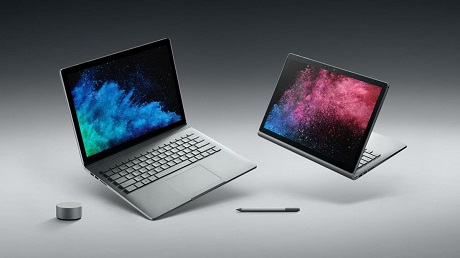
 Microsoft Surface laptops are now eligible for “recommended” status in Consumer Reports’ ratings. Last year we removed that designation because of poor predicted reliability in comparison with laptops from other brands. Reliability evaluations are based on surveys of our members. We now have results from our latest survey. “Microsoft’s reliability is now on par with most other laptop brands,” allowing its products to be recommended, says Martin Lachter, a senior research associate at Consumer Reports. This is the first year that brand reliability is being factored into the Overall Scores for many products rated by Consumer Reports. Owner satisfaction, which is based on the same survey of our members, is also being incorporated into the Overall Score. The new reliability scores are ready just as we’ve completed our lab testing of the recently released Microsoft Surface Go. That 10-inch Surface Go, released in August, is meant to be a two-in-one laptop, though a keyboard must be purchased separately. The Surface Go isn’t receiving a CR recommendation, but that’s based on the results of lab testing, not member survey data. The Surface Go is the only Surface that isn’t getting a recommendation; the company’s other models, including the Surface Pro, Surface Laptop, and Surface Book 2, do score well enough to be recommended. (Based on feedback from Microsoft, we are testing and rating these devices as laptops; last year we considered some Surface products separately as laptops and as tablets.) Learn more by visiting OUR FORUM.  Cloudflare announces today support for encrypted Server Name Indication, a mechanism that makes it more difficult to track user's browsing. A web server can host multiple websites, with all of them sharing the same external IP address. This is possible through virtual hosting, a method that allows splitting the resources among available domain names. Server Name Indication (SNI) is a component of the TLS protocol that makes it possible for a server to present different TLS certificates that validate and secure the connection to websites behind the same IP address. An application with SNI support includes the hostname it is trying to reach the beginning of the handshake process with the server. This initial conversation in the TLS negotiation process happens in the clear, exposed to every node along the way, allowing an observer to track users or to influence (block, slow down) the connection to websites it does not sympathize. An encrypted SNI (ESNI) eliminates the risk of exposing the destination name. Learn more on OUR FORUM.  Along with Material Design, the latest version of Google’s popular Chrome browser also brings along some under the hood changes which may not be as desirable to users concerned about their privacy. With Google Chrome 69, logging into any Google service such as Gmail or YouTube will now also log you into the browser itself, which means a large number of items will automatically be uploaded to Google’s servers, where they can presumably be indexed, a user and ad profile be created or subpoenaed for your divorce proceedings. Prior to this users had to consciously log into the browser, and users who were not logged in had their bookmarks, browser, and other items stored only locally. Google’s privacy policy makes the difference between logged in and logged-out (basic browser) mode clear. I suspect at this point most of us have given up the fight to keep our data on our own computers and out of the cloud, but for those who are still fighting the good fight, and who are rightfully outraged by this, besides protesting loudly may also want to use an alternate browser focussed on privacy such as the Brave browser. Keep up to date and visit OUR FORUM. |
Latest Articles
|