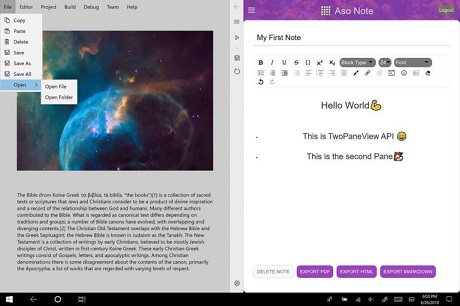
 Microsoft has patented yet another design for a dual-display device. The latest patent is about “multi-display systems” which could be a traditional desktop, notebook or tablet computers, hand-held personal digital assistants (PDAs). It appears that the patent has nothing to do with the long-rumored Andromeda dual-screen device as there’s no mention of the hinge in the patent application. First discovered by us, the patent titled “MULTI-DISPLAY SYSTEM” was published by the United States Patent and Trademark Office on August 9, 2018, and it was filed by Microsoft in February 2017. The patent basically explains the techniques that would correct misalignment issues in a multi-display system by identifying a misalignment between a plurality of displays in the multi-display device. “As computer systems have increased in power and capacity that allow for multiple applications to run concurrently, it has become commonplace for computer systems to include more than one display device or monitor. Systems with multiple displays (or “multi-display systems”), however, are not limited to traditional desktop systems. Instead, multi-display systems can be implemented in a variety of systems, including notebook or tablet computers, hand-held personal digital assistants (PDAs), multiscreen television systems, etc. Even further, many multi-display systems are implemented without being connected to a computer system,” Microsoft writes in the background section of the patent. More on this patent can be found on OUR FORUM.  Microsoft today announced a partnership with Agile Networks to bring high-speed internet access to 110,000 currently unserved people in rural areas in Ohio. Microsoft will make use of Agile’s telecommunications infrastructure throughout the state including TV white spaces, to provide broadband internet for the next four years. This high-speed internet will enable many critical functions in medical clinics and rural hospitals, schools, oil and gas wells, agriculture operations, and households. “In today’s digital economy, broadband access has become a necessity across industries including healthcare, agriculture, business, and education,” said Shelley McKinley, Microsoft’s head of Technology and Corporate Responsibility. “Our partnership with Agile will help deliver broadband internet access to rural communities across Ohio so that they can take advantage of today’s and tomorrow’s opportunities and the latest cloud technologies.” “People across the state, no matter where they choose to live, work and send their children to school, should have the same access to strong, reliable broadband service,” said Kyle Quillen, Agile Networks Founder, and CEO. Follow this trend on OUR FORUM.  The Internet is an awesome place filled with knowledge and ideas. It lets us access information anywhere and lets us connect with friends and family no matter where we may be. The beauty of the Internet is in its neutrality. It doesn’t care what color we are, what gender we identify as, or how large (or small) are our bank accounts are. But, the Internet is under siege. If you’ve been on the web recently, chances are you’ve already heard about the ongoing war for net neutrality. It’s an urgent matter that affects us all- whether you’re a consumer or enterprise. Read on to find out more about the current situation and what you can do about it. |
Latest Articles
|