Microsoft has announced that Windows will begin blocking ReFS-formatted USB drives and external storage devices by default starting January 2027, as part of a broader effort to improve operating system security. The change will affect Windows 11, supported Windows 10 installations, and Windows Server, although the vast majority of users are unlikely to notice any difference.
According to an
official Microsoft support document, published on October 13, 2026, the company is introducing new restrictions on how Windows handles removable storage devices formatted with the
Resilient File System (ReFS).
Microsoft Is Tightening Security Around ReFS, With External Drives Set To Be Blocked By Default In January 2027For those unfamiliar, ReFS is Microsoft's relatively modern file system, designed primarily for enterprise and server environments. Compared to the widely used
NTFS (New Technology File System), ReFS offers several advantages, including improved data integrity, greater resilience against corruption, support for extremely large volumes, and features such as block cloning that can significantly accelerate certain file operations.Microsoft has also expanded its use beyond servers, notably introducing ReFS-based Dev Drives in Windows 11 to improve performance for development workloads.
However,
ReFS has never officially supported removable storage devices, including USB flash drives and external HDDs or SSDs. Although Windows has generally allowed users to mount such volumes, Microsoft is now moving to restrict these unsupported configurations.
The rollout will take place in two phases:
>
October 13, 2026: The initial security update introduces auditing by default.
Windows records affected ReFS volumes in Event Viewer under Event ID 524, but continues allowing them to mount.>
January 2027: The enforcement phase begins,
with Windows automatically preventing affected ReFS volumes from mounting unless an administrator explicitly overrides the restriction.More importantly, this change does not erase the contents of affected drives. However, users may find themselves unable to access their files through Windows once the restrictions take effect.
Microsoft says the decision is intended to reduce exposure associated with unsupported storage configurations, although it has not identified a specific vulnerability responsible for the change.
 Microsoft's Resilient File System (ReFS) was designed to improve data integrity, resilience against
corruption, and storage scalability. However, Microsoft has never officially supported ReFS on
removable storage devices, and Windows will begin blocking affected external volumes from
mounting by default starting January 2027.Here's What Affected Windows Users Can DoFortunately, the change should have little impact on typical consumers. USB flash drives and external storage devices generally use
FAT32, exFAT, or NTFS, none of which are affected by this particular restriction.Those using ReFS-formatted external storage should consider transferring their files to a supported configuration before January 2027.
Users can check their drive's file system through the Properties menu in Windows File Explorer.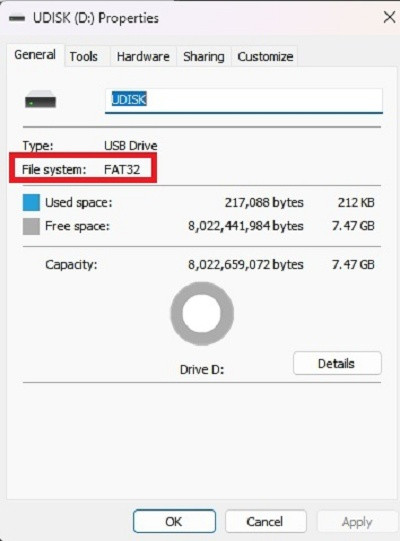 Checking a USB flash drive's file system under the Properties menu of Windows Explorer.
For advanced users and system administrators, Microsoft has also introduced a configurable registry and Group Policy setting called
RefsRemovableDeviceMountPolicy.This setting supports three values:
0 disables the restriction, 1 enables auditing, and 2 blocks affected volumes. Any configuration changes require a system restart, while Group Policy takes precedence over local registry settings.
Although Microsoft provides a way to override the restriction, migrating affected workloads to supported storage remains the recommended long-term solution.
For most Windows users, January's change will pass unnoticed. Nevertheless, enthusiasts and administrators relying on ReFS-formatted external drives should prepare accordingly to avoid unexpected accessibility issues.
source
