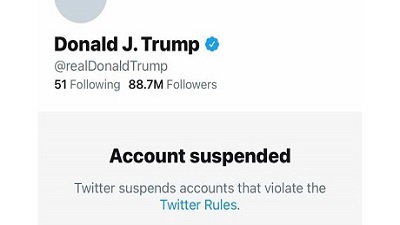
 "After a close review of recent Tweets from the @realDonaldTrump account and the context around them we have permanently suspended the account due to the risk of further incitement of violence," Twitter's official "Safety" account tweeted. Twitter permanently suspended President Donald Trump’s account on Friday, citing “the risk of further incitement of violence.” The president’s account, with 88 million followers, was initially banned for 12 hours on Wednesday due to “severe violations of our Civic Integrity policy,” after he used the platform to condemn Vice President Mike Pence as his supporters stormed the Capitol. “After a close review of recent Tweets from the @realDonaldTrump account and the context around them we have permanently suspended the account due to the risk of further incitement of violence,” the company said in a tweet. Almost immediately, the account that Trump had used for years to convey his every thought, to denounce his enemies and praise his friends, to convey uncountable false statements and official White House announcements, simply disappeared. It was suddenly impossible to see his previous tweets or even to see his reaction to Twitter's decision. Instead, his empty account had been marked: "Account suspended." Trump's attempts to tweet from associated accounts also were blocked. At one point, he was tweeting from his campaign account, but that was promptly suspended. In a blog post, Twitter detailed the reasoning behind the decision. “In the context of horrific events this week, we made it clear on Wednesday that additional violations of the Twitter Rules would potentially result in this very course of action,” Twitter wrote. “Our public interest framework exists to enable the public to hear from elected officials and world leaders directly. It is built on a principle that the people have a right to hold power to account in the open.” “However, we made it clear going back years that these accounts are not above our rules and cannot use Twitter to incite violence,” the post continued. “We will continue to be transparent around our policies and their enforcement.” The White House did not respond to a request for comment. Twitter banned the president’s account after years of public pressure and several attempts to limit the reach of his account in recent days. Hundreds of Twitter employees recently signed a letter urging Twitter CEO Jack Dorsey to ban the president from using the platform to incite violence in the wake of the Capitol siege. An employee at Twitter who has been pushing for the company to delete the president’s account this week told NBC News that “leadership took a beating” at a meeting Friday morning with employees, many of whom pleaded with executives to delete his account. This was the second time in a week Twitter had taken action against the president’s account. Twitter removed three tweets that promoted conspiracy theories about the election and locked Trump’s account on Wednesday, citing “a risk of violence,” after a violent riot at the Capitol. Trump’s official @POTUS account is still active, but if the company determines he’s using it to evade the ban, it will take action to limit its use, a Twitter spokesperson said in a statement. About two hours after his ban, Trump did turn to the official @POTUS account, railing against Twitter, Democrats, and “the Radical Left,” in a series of tweets that were quickly deleted. A Twitter spokesperson said, “As we’ve said, using another account to try to evade a suspension is against our rules. We have taken steps to enforce this with regard to recent Tweets from the @POTUS.” Learn more about this very bold and appropriate move from Twitter on OUR FORUM.  If you’ve been following the tech industry over the past year, you no doubt know that Huawei is in a heap of trouble. Since May of 2019, the Chinese company has been under fire from the United States government, resulting in what is colloquially referred to as the “Huawei ban.” This ongoing battle has forced Huawei to drastically change its business practices. If you are curious as to how the Huawei-US ban came to be, the details surrounding the ban, and what it means for Huawei going forward, this is the place to be. Below, you’ll find all the integral info related to the ban. We’ve also got some helpful tips specifically related to Huawei’s smartphones and how the ban affects both current and future handsets. With the Huawei-US ban in effect, the company has had to completely revamp how it creates and releases smartphones. It also faces mounting scrutiny from other nations, many of which rely on Huawei for wireless networking equipment. Since May 2019, Huawei has had some minor wins, but the bulk of the ban is still in place. It appears the Huawei ban will be in effect in perpetuity and the company will need to strategize around it until further notice. In the grand scheme of things, Huawei is a relatively young company. Ren Zhengfei started Huawei in 1987 after he was discharged from the People’s Liberation Army in China. Zhengfei’s military history helped Huawei get some of its first big contracts. This is one of the main reasons Huawei is viewed as a de facto branch of the Chinese government. Huawei has faced scrutiny from the beginning for allegedly stealing intellectual property. In brief, the company would be accused repeatedly over the decades of stealing technology from other companies and then passing it off as its own. There are a few times where this has been proven, such as with a 2003 case filed by Cisco, but there are many other times where accusations didn’t lead to confirmation. While Huawei was growing at an astounding rate in 2018, all was not well in regards to its home country. Donald Trump started to flex his power as POTUS to combat China and its “unfair trade practices,” as he called them. This began the still-ongoing US/China trade war. Although the trade war has a lot to do with politics, tariffs, and international law, it also touches on intellectual property theft. Since Huawei has a reputation as a repeat offender when it comes to IP theft, this put the company in Trump’s crosshairs. However, critics at the time noted that a long-term US/China trade war would hurt both countries significantly. Because of this, it was assumed that Trump would try to strongarm deals from China that would be advantageous to the US and then be done with it. On May 15, 2019, President Trump issued an executive order that bans the use of telecommunications equipment from foreign firms deemed a national security risk. The order itself doesn’t mention Huawei (or even China) specifically. However, the US Department of Commerce created what it refers to as an “Entity List” related to the order that does contain Huawei’s name. Since the order didn’t reference Huawei specifically, its effect on the company and its various lines of business wasn’t totally clear. It appeared the order was mostly directed towards Huawei’s telecom operations, which would mean its wireless networking equipment, especially those related to 5G. The order also didn’t make it clear whether the US government would help carriers pay for the removal of Huawei equipment. It also didn’t clarify any punishments US companies would face if they didn’t comply with the order. In brief, the Huawei ban seemed serious but there were too many unknowns to understand where it would go. Get all the details on the Huawei Ban by visiting OUR FORUM.
 After WhatsApp updated its Privacy Policy and Terms of Service on Monday with additional info on how it handles users' data, the company is now notifying users through the mobile app that, starting February, they will be required to share their data with Facebook. "Respect for your privacy is coded into our DNA," the company said earlier this week. "Since we started WhatsApp, we've built our Services with a set of strong privacy principles in mind." However, despite its focus on users' privacy, WhatsApp is now giving its users a harsh ultimatum, with only three options available: to accept sharing their data with Facebook, to stop using the app altogether, or to delete their accounts. The new updates are definitely a 180-degree turn when compared with last year's privacy policy, enforced starting with July 2020, which says that users are able to choose not to have their WhatsApp account info shared with Facebook to improve your company's ads and products. With the new changes to the policy, users will now be forced to accept sharing their data with Facebook to continue using their account or, as an alternative, delete their accounts as WhatsApp says. "By tapping AGREE, you accept the new terms and privacy policy, which take effect on February 8, 2021," WhatsApp's notification says. "After this date, you'll need to accept these updates to continue using WhatsApp. You can also visit the Help Center if you would prefer to delete your account and would like more information." This week's privacy policy updates, however, also state that WhatsApp will now share the users' data with the other 'Facebook Companies' — this will happen even if the users do not have a Facebook account and have never used Facebook before. Facebook companies that will gain access to WhatsApp users' data once the new policy changes take effect in February include Facebook, Facebook Payments, Onavo, Facebook Technologies, and CrowdTangle. "We may use the information we receive from them, and they may use the information we share with them, to help operate, provide, improve, understand, customize, support, and market our Services and their offerings, including the Facebook Company Products," WhatsApp explains. "The information we share with the other Facebook Companies. includes your account registration information (such as your phone number), transaction data, service-related information, information on how you interact with others (including businesses) when using our Services, mobile device information, your IP address, and may include other information identified in the Privacy Policy section entitled ‘Information We Collect’ or obtained upon notice to you or based on your consent." Information collected by WhatsApp from its users also includes location data, payment information, as well as device diagnostics data. While WhatsApp previously allowed users to download collected account information, the company was forced to provide additional information on how its apps' are handling user data starting with December 2020, after Apple started requiring it from all applications listed on its App Store. At the moment, the Apple App Store privacy labels on WhatsApp Messenger's entry says that the app is collecting and linking the following type of data to its users' profiles: Follow this thread on OUR FORUM. |
Latest Articles
|